
Find Out Who Owns a Cowley County Property
Two county records do different work here. The parcel roll points to OwnerName. The newest deed names the grantee of the last recorded transfer. Skip neither step when ownership matters to a purchase, an estate, a boundary issue, or a suspected recording problem.
- Enter the known address in Cowley County's public map or Schneider Beacon route.
- Open the parcel and save OwnerName, PIN, situs, mailing address, and legal description.
- Ask the Register of Deeds for the latest conveyance that matches the parcel's legal description.
- Compare the grantee and vesting language with the roll, allowing for a recent transfer lag.
- If the grantee is a Kansas entity, verify its exact legal name and status through the Secretary of State.
This trail identifies the public owner of record. It does not reveal who lives at the address or grant permission to contact an occupant.
Cowley County Property Owner Field: OwnerName
The county's parcel REST layer exposes the exact field OwnerName. It sits among mailing-address fields, situs fields, PIN, KSPID, QuickRefID, legal description, value, characteristics, ValidSale, Book, and Page. That layout makes an owner check easier. One parcel view lets a researcher compare identity, location, and deed-reference clues side by side. The official parcel service publishes them all.
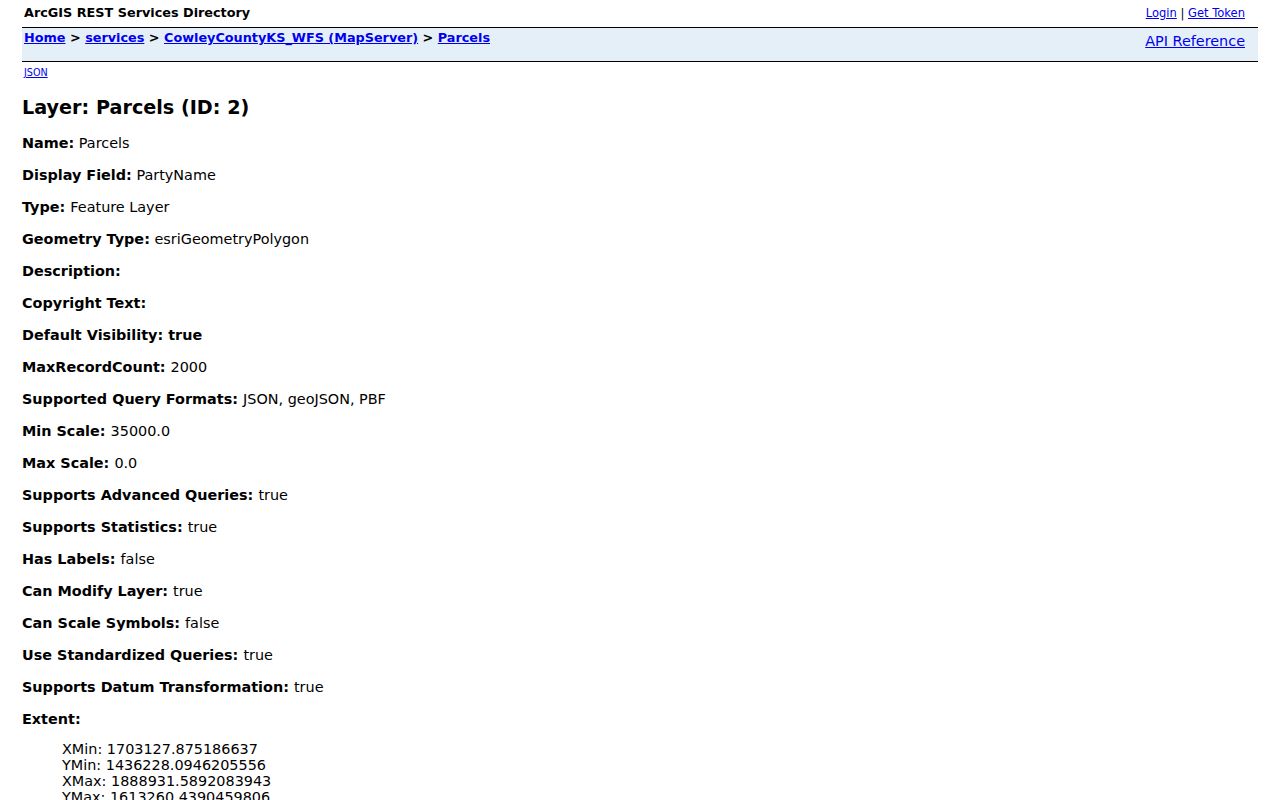
The field names explain one common trap. A mailing address is not the property's location. Book and Page are references too, not the deed image or all of its terms.
Confirm a Cowley County Property Owner
The Cowley County Register of Deeds is the confirmation layer. That office records deeds and other instruments affecting real property. The county page offers no verified public Cowley grantor-grantee index. Use the courthouse counter, the telephone, mail, or a written request form instead.
Match the parcel's legal description, not merely a similar address. A request can cite quarter-section, section, township and range. It can also cite subdivision, block and lot. The parcel number works too, and so does a street address. Include Book and Page when a parcel result shows them. Electronic instrument copies cost $1, and physical copies run $1 per page plus postage.
The latest deed names the grantee and states how title was vested. A parcel roll can lag a closing. The County Clerk transfers ownership on the real-estate roll only after the recorded conveyance enters the county workflow. The transfer waits on that recorded conveyance.
Where Cowley County Ownership Is Recorded
Several sources display an owner's name. They differ in weight and currency. Each answers one question. Use the parcel roll to find the candidate, the deed to confirm the transfer, the map to verify the parcel, and the entity record only to understand a business grantee.
| Source | Owner Info It Gives | Access |
|---|---|---|
| Parcel and assessment roll | OwnerName, mailing, situs, parcel and value fields | Current administrative roll; may lag a recent deed |
| Latest recorded deed | Grantor, grantee, vesting and legal description | Current through the newest instrument located |
| GIS parcel layer | Mapped parcel attached to owner and legal fields | Reference geography, not surveyed title |
| Kansas entity search | Entity spelling, status, resident agent and filings | Entity context, not proof that an agent owns land |
An occupant may be a relative, guest, or caretaker. That person may never appear in the ownership record. Likewise, an owner's tax mailing address can lie elsewhere. The task is identifying the titled or recorded party, not guessing who is inside a home.
Read Cowley County Property Owner Names
A Cowley County property owner may show up as an LLC, corporation, trust, estate, or pair of joint names. Search the wording exactly as it appears in OwnerName. Then test sensible spacing and punctuation variants. For an entity, use the Kansas Secretary of State Business Entity Search by business name or SOS ID.
The entity result shows status, legal spelling, resident agent, office, and filing history. None of that proves personal ownership. An officer or member is not automatically the owner. The entity is the deed grantee unless the recorded instrument says otherwise.
Trust and estate names demand the same restraint. A trustee acts in a stated capacity. An estate transfer may need a probate file to explain the authority behind a later deed, so match names and capacity language across the deed, the court record, and the parcel roll.
Note: Search exact entity wording first, then abbreviations and punctuation variants, while keeping the parcel's legal description fixed as the match key.
When a Cowley County Property Owner Changes
The assessment roll exists for administration and tax work. It was never built for instant closing updates. In Cowley's documented process, the recorded conveyance lands with the Register of Deeds. The County Clerk handles the real-estate ownership transfer. No official source quotes a fixed local lag in days. A seller may still sit in OwnerName weeks after closing. Compare the recording date and legal description on the newest deed. A deed accepted after the last roll refresh can be the fresher public record. Treat it as such rather than inventing a standard update period or assuming the parcel card changed on closing day.
Owner of record: the name currently carried on a public roll. Grantee: the party receiving the interest in a deed. Vesting: how the deed states ownership is held; situs is the property's physical location, distinct from the owner mailing address.
Alerts for a Cowley County Property Owner
After learning who owns a property in Cowley County, owners can stay watchful. The Register of Deeds offers a free Property Activity Alert. Signing up is simple. The service sends a notice whenever a document is recorded under a monitored name. This makes it a useful follow-up. Confirm the owner of record through the deed records first.
Know what the alert covers. It works by name only. A notice does not prove it relates to your parcel. Nothing is blocked from recording, and the alert cannot judge whether an instrument is fraudulent. People with common surnames should compare each notice against the parcel number. Check the legal description too before drawing conclusions.
The county's alert form page shows the official sign-up route.
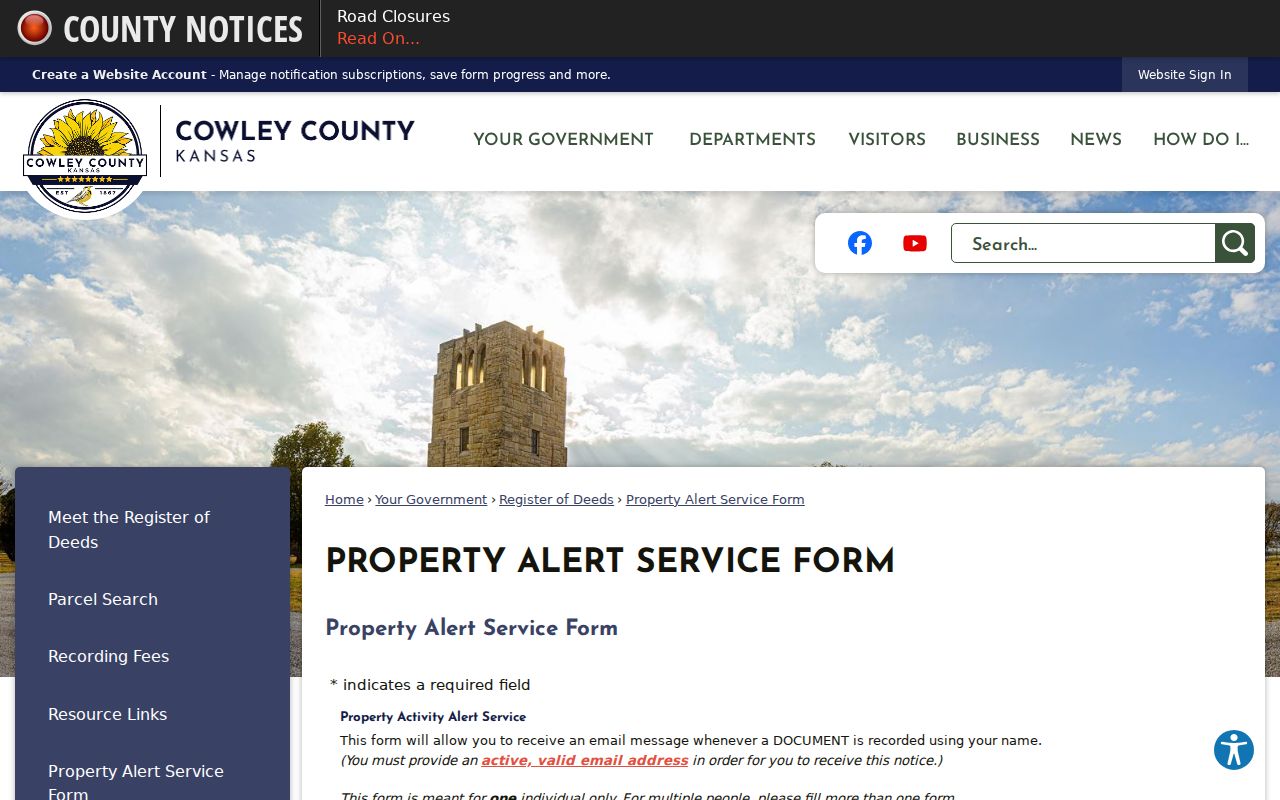
The form is a tool for future recordings only. Finding the current owner of record still runs through the tax roll and the newest deed.
Cowley County Property Owner Versus Occupant
Cowley County handles addresses in layers. Mailing, situs, E911, and legal-description systems can each track the same parcel. They can show a different string for that parcel, all for legitimate reasons. Outside Winfield and Arkansas City, the E911 policy relies on a rural section grid. That grid pairs with GPS entryway points. One parcel can carry multiple address points. A new Appraiser situs does not always overwrite an established 911 address.
These quirks matter when matching an address. They do not, however, make an address proof that someone lives there. Historical city directories and local collections may name a resident from an earlier era. Treat those finds as context. Then reconcile them with the deed records whenever the question is ownership.
For detail straight from the present roll, there is one right stop. The Cowley County current owner guide is that stop. This page stays on the broader route from land to owner to recorded confirmation.
Limits on a Cowley County Property Owner Search
A public owner name is a lead, not a title opinion. The parcel roll can lag behind a recent sale. Deed records may hold interests or exceptions a basic owner lookup never surfaces. GIS lines are tax-reference geometry, not a boundary survey. Kansas Safe at Home can also shield a participant's address in covered public displays.
Never let a commercial compilation stand in for the custodian record. Do not rely on any owner conclusion yet. First verify the parcel, the legal description, the newest deed, and any relevant court file.
Lawful use. Cowley County owner records support purchase due diligence, estate research, boundary work, deed-fraud review, and civic transparency. Never use them to stalk, harass, intimidate, trespass, or harm anyone.