
Cowley County Owner Record Fields
The Cowley County parcel service exposes the fields that separate a current owner from the land. Its schema lists OwnerName, separate owner-mail fields, SitusAddress, parcel keys, a legal description, value fields, a valid-sale marker, and book and page references. Treat these as schema fields, nothing more. No parcel is guaranteed to carry a value in every box. An empty field is not an error by itself.
| OwnerName | Name carried on the current assessment record |
|---|---|
| OwnerAddr fields | Destination for owner correspondence |
| SitusAddress | Street location assigned to the parcel |
| PIN, KSPID, QuickRefID | Keys that keep the search tied to one tract |
| LegalDesc | Lot, block, subdivision, or land description |
| ValidSale, Book, Page | Clues pointing toward a transfer source |
A tax-mailing address never proves the owner lives at the site. Match the current owner record by parcel key and legal description, not by a shared surname. That discipline prevents most false identifications.
OwnerName on Cowley County’s Parcel Layer
The exact local label matters more than you might think. OwnerName names the party carried in Cowley County parcel data, while a party name in another system may identify someone merely linked to a filing. Start with the current parcel field. Preserve punctuation, initials, trust wording, and company suffixes exactly as recorded, because a dropped period or initial can split one owner into two apparent people.
The live Schneider Beacon page offers no confirmed screen layout or refresh cadence. The county GIS Services page, its map instructions, and the REST schema still establish the address, parcel, owner, and map route. If the interface fails, save the address and call the Appraiser. An unofficial directory is never a substitute for the county itself.
Cowley County Owner Mail Versus Situs
Situs means the location of the real estate. Mailing fields show where tax correspondence goes. Those two values can differ without any error existing. An entity may receive mail through an office, an estate through a representative, or an individual at a second address. Keep both visible while comparing PIN, KSPID, Quick Reference, and LegalDesc.
- Owner of record
- The person or entity named on the present assessment roll.
- Assessment roll
- The county record organizing parcels, owners, classes, and values.
- Situs address
- The physical address assigned to the parcel.
- Recording lag
- The time between a deed filing and a later roll update.
Cowley County's E911 policy adds a wrinkle. A new Appraiser address does not always replace an existing 911 property address, and more than one address point may exist. Resolve any mismatch through the parcel key and the deed rather than through the address alone.
How Fresh Is Cowley County Ownership?
Cowley County publishes roll milestones. No county source states a typical number of days from closing to an updated owner field. The Kansas calendar moves through valuation notices, certification, and the tax roll. Cowley's 2026 value notices were mailed March 1 with an authorization-code viewing route. None of those dates proves that yesterday's sale appears today. The County Clerk's real-estate unit transfers ownership on all real-estate parcels after recorded conveyances. That lag explains the gap. The roll's current owner can trail the grantee on a new deed. Ask the Clerk or Appraiser which owner the roll carries. Ask the Register of Deeds for the newest instrument.
Freshness check. A parcel roll may lag a recent sale. The newest recorded deed is the stronger current-owner check.
Confirm a Cowley County Current Owner
Use the roll as the quick index and the deed as recorded confirmation. That two-step check is the sound method. Cowley County publishes no confirmed local grantor-grantee web index or cutoff year. The office request route is therefore essential.
- Search by address, full or compact PIN, Quick Reference, or section-township-range and copy
OwnerName. - Save the situs, mailing fields, parcel keys, and full legal description.
- Use the recording information request for the latest deed and book, page, or instrument reference.
- Compare the grantee, recording date, and legal description. Ask the Clerk or Appraiser about a mismatch.
The request form accepts address, parcel number, quarter-section-township-range, subdivision, block, and lot. Electronic copies cost $1 per instrument. Physical copies cost $1 per page. Email, phone, mail, and in-person contact are all documented channels.
Cowley County Entity Owners Need Exact Names
A current owner may be an LLC, trust, estate, or other entity. Never swap its legal name for a person who merely seems linked to it. Search the exact entity string in the Kansas Business Entity Search, which supports entity name, SOS ID, and resident-agent modes. Only the first 200 results are returned, so precise spelling helps. A registered agent is the filing contact, not necessarily the landowner personally. A trust may hold title while a trustee's authority appears only in the deed. Estate wording may call for a probate check. These distinctions keep the current-owner inquiry tied to recorded vesting.
Cowley County Parcel Keys Prevent Mix-Ups
Common names and repeated rural addresses can produce false matches. Cowley's map instructions support address, parcel number, Quick Reference, and section-township-range searches. Carry at least one durable key into each phone call and deed request. For a city lot, add subdivision, block, and lot. For rural land, retain quarter, section, township, and range. The legal description matters most when an address changed or a tract split. The Register of Deeds requires a full legal description in recorded documents. A short tax description may locate a tract. But it should never replace the deed description.
Note: Cowley GIS supplies tax and reference data. The deed and legal description carry the stronger ownership link.
Cowley County Current Owner Schema
The official parcel layer makes owner, mailing, situs, key, value, and sale-reference labels visible even when a vendor card cannot be opened. The Cowley County data stays readable through the layer itself, so the details remain available.
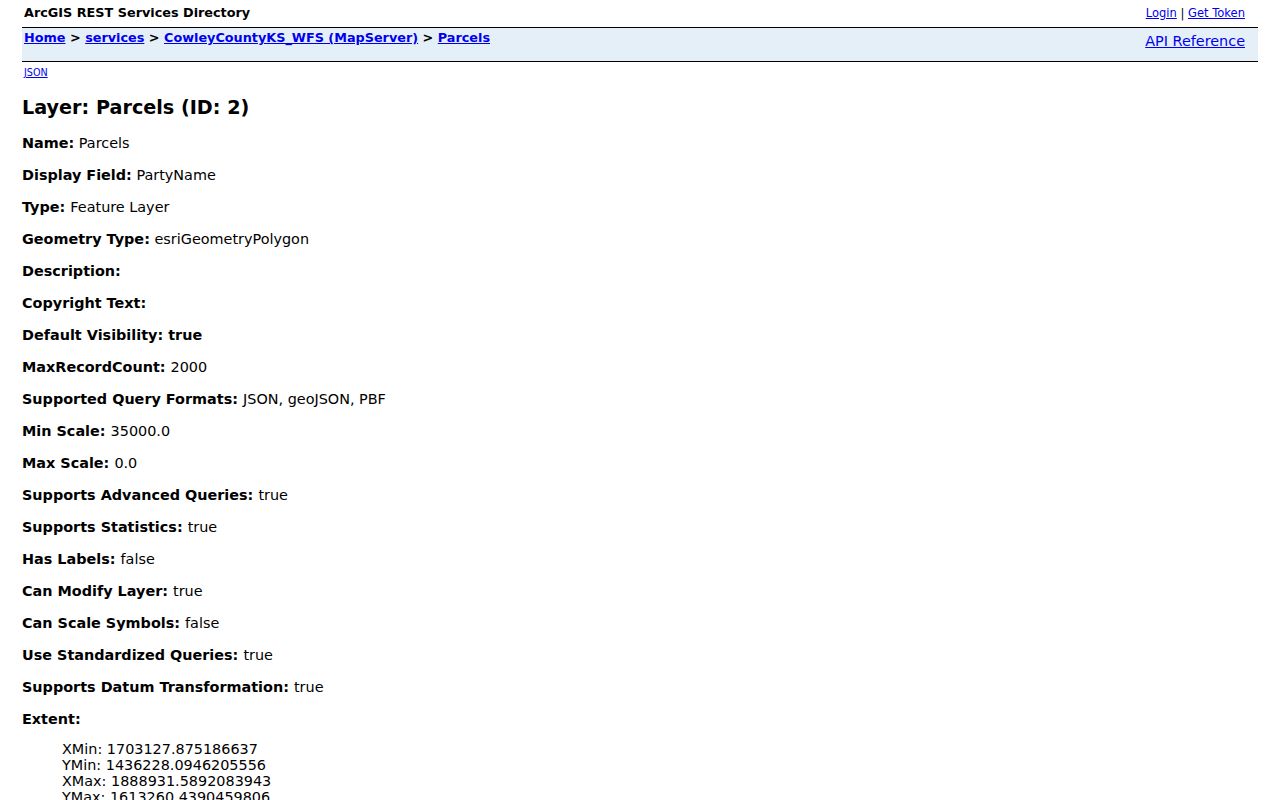
The image is a field inventory, not a selected person's record. Use it to know what to save, then obtain the live parcel from the Appraiser.
Limits on Cowley County Owner Records
Cowley County property records list the owner of record for each parcel. That name supports deed-fraud checks, tax questions, estate work, and lawful contact about land. Still, it has limits. The current owner field does not name every occupant. It may lag behind a recent deed filing. A GIS polygon is not a legal survey.
Lawful use. Use Cowley County owner data for legitimate property research. Never use an address or owner detail to harass or harm anyone.
When a disputed interest needs sorting out, a Kansas attorney or title professional can examine rights that no parcel card will resolve. The Cowley County ownership method walks through the broader process.
Cowley County Transfers Pass Through the Clerk
Ownership moves through the County Clerk's real-estate unit in Cowley County. That office transfers ownership on all real-estate parcels. It stands between the recorded deed and the tax-roll view a searcher sees. When the latest deed and OwnerName disagree, contact the Clerk or Appraiser. Give them the recording date, the grantee, the PIN, and the legal description. Ask plainly whether the conveyance is waiting on a roll update.
A mismatch is not proof of an invalid deed. It is not proof of a county error either. Processing delays, partial tracts, corrections, and estates can all explain the gap. Some filings simply need closer review. Preserve both dates, and note which source named which party. That record-keeping makes the follow-up far easier. It helps with the Recorder of Deeds or the Appraiser's office when you work through the parcel record.
Cowley County Property Alerts Watch Names
The Cowley County Property Activity Alert watches names instead of parcels. It sends notice whenever a document is recorded using a registered name. The form takes one individual per signup and relies on email plus reCAPTCHA. Treat it as a monitoring tool. It is not a current-owner search. It does not guarantee that a filing is valid.
Register the exact owner or entity name from the deed. If an unexpected instrument appears, the alert gives you a reason to check quickly with the Register of Deeds. The service cannot block a document or settle title. Reviewing the parcel and deed records yourself still matters.